Pages

Thursday, October 6, 2011

Understanding Credit Scoring & Credit Repair

Seek a Qualified Mortgage Consultant to Ensure the Best Results
Understanding Credit Scoring &
Credit Repair
 
By Jerry R. Dudley, Jr., Business Development Manager
LeaderOne Financial Corporation
Raymore, MO – Credit remediation is a subject consumers often face with fear and trepidation, and for good reason. With the exception of recognizing that the best score wins, the average home shopper knows very little about the whole credit scoring process. Sub-prime borrowers who are eager to move into A-Paper territory often find themselves at a loss when trying to find ways to upgrade their credit history. The good news is there are ways to improve less-than-perfect credit scores and obtain a loan for the home you really want.

The first step in the process is making sure that you have a current copy of your credit report. Congress recently amended the Fair Credit Reporting Act so that consumers may now receive one free credit report annually. There are three major credit bureaus: Equifax, Experian, and Transunion. Since entries can vary across bureaus, you’ll want to request a free report from each of the three companies. (Go to www.annualcreditreport.com)

It's also important to know just what a good credit score is. Most A-Paper scores generally begin around 680, although this number may differ slightly among lenders. Don't despair if you come up shy, there is always room for improvement. Increasing your score just 5 points can save a significant amount of money. For example, if your score is 698 and you increase it to 703, then you could save yourself thousands of dollars over time as a result of a slight improvement to your loan’s interest rate.

While credit repair is necessary for some, it's not the only way to increase your credit score. Even if you have stellar credit, you can enhance your score through these steps:

·         Evenly distribute your credit card debt to change the ratio of debt to available credit. Let's say you have a credit score of 665. If you have debt on only one card, and four additional credit cards with zero balances, evenly distributing the debt of the first card could move you closer, and possibly into, that ideal bracket.

·         Keep your existing accounts open and active. The average consumer is usually anxious to close credit card accounts that have zero balances, but doing this can cause them to lose the benefits of a long-term credit history and increase their ratio of debt-to-available credit. The bottom line is don't close those old accounts!

·         Keep credit inquiries to a minimum. Each inquiry into your credit history can impact your score anywhere from 2-50 points. When it comes to mortgage and auto loans, even though you're only looking for one loan, multiple lenders may request your credit report. To compensate for this, the score counts multiple auto or mortgage inquiries in any 14-day period as just one inquiry, so try and stay within that time frame.  

Remember, credit scores don't change overnight. Improving them requires time and diligent effort on your part, so it's a good idea to get the ball rolling at least three to six months prior to submitting your application for home financing. 

If credit repair is what you need, you can either begin the process yourself or seek out a repair service. If you decide to make your own improvements, visit as many websites as possible to get information regarding credit laws and consumer rights. Diligently search through them and educate yourself to ensure that you don’t sustain any self-inflicted wounds. A good place to start would be the Federal Trade Commission's website, which contains a wealth of helpful literature. 

If you’re facing severe or complicated credit issues, then you’ll probably want to enlist the assistance of a professional credit repair company. Before you do, be sure to familiarize yourself with the FTC's regulations on credit repair. With over 1100 credit repair companies to choose from, it's important to be certain you are dealing with a reputable firm. Examine the FTC's information on fraudulent practices to avoid falling prey to credit repair scams.

Addressing credit issues can be uncomfortable to say the least. But by taking these steps now, you’ll be that much closer to obtaining the home of your dreams.

Additional Resources:

To order your free credit report, go to:

To read the Fair Credit Reporting Act, go to:

For the Federal Trade Commission's information on consumer credit, go to:


Jerry R. Dudley, Jr. is affiliated with LeaderOne Financial Corporation, a Licensed Mortgage Bank, Missouri, Kansas, Nebraska, Iowa Department of Real Estate.


# # #


SUBMITTED BY:
Jerry R. Dudley, Jr.
913-890-3249
FAX: 913-647-7247

Wednesday, August 31, 2011

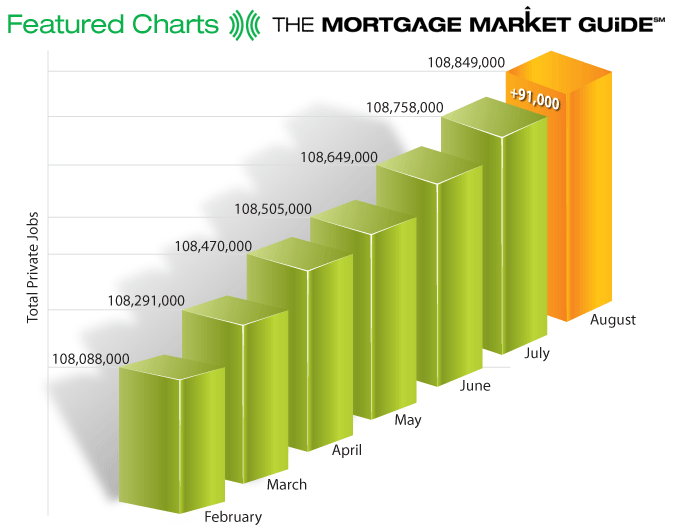
ADP Employment Rises 91,000 in August


Featured Charts

ADP Employment Rises 91,000 in August
This chart illustrates the most recent ADP employment report released today showing an increase of 91,000 private-sector payrolls in August. These numbers suggest a recent trend of modest employment growth. Markets use this report as a gauge on the U.S. government's job estimate which will be released on Friday.

©2011 MSS, LLC. All rights reserved.
 

Monday, July 11, 2011

Move or Remodel?

For immediate release July 11, 2011

Ready to Trade-In Your Home?
Perhaps You Should Remodel Instead!
 
By Jerry R. Dudley, Jr., Business Development Specialist            
Leader One Financial

LENEXA, KS – Each year, millions of Americans move into the home of their dreams. As time goes by, families expand, kids grow older, and suddenly that home isn't quite so perfect anymore. Or perhaps you still love your home, but you really want a gourmet kitchen and a larger master bedroom. Should you start looking for a new house? Or would it be better to stay where you are and remodel instead?

Both options involve a significant investment of time and money, so it's important to take your time and make an informed decision. You'll also want to be sure to consider both the financial and the emotional sides of the equation. Let's begin by examining the financial factors involved.

Moving: A good local real estate agent should be able to assist you with estimates on these numbers.

·   How much will it cost to purchase a home that will meet your needs?

·   How much could you sell your existing home for? Don't forget to subtract the agent's commission from this total.

·   What will it cost to move? According to real estate consultant and best-selling author of Remodel or Move, Dan Fritschen, a typical move costs 10% of the value of your home.

·   How much will your property taxes increase as a result of the move?

Remodeling:

·   What projects do you want to have done and how much will they cost? An architect or general contractor will be able to assist you with these figures.

·   How much will the improvements add to the value of your home, also known as the "payback"? A local real estate agent can assist with this as well.

If the decision about whether to renovate or move were purely a financial one, then it would be quite easy to look at the numbers and come to the right conclusion. However, there are also emotional factors that come into play, and they have a value as well. Let's consider some examples.


Reasons you may want to move:

·   If you relocate to a new neighborhood, your children could attend superior schools.

·   You would like to reduce your commute or have better access to local amenities, such as restaurants and shopping.

·   You're not particularly fond of your current neighborhood.

·   Your yard is too small, and you cannot expand it.

Reasons you may want to stay and remodel:

·   You're happy with your location. It's convenient, you love your neighbors, and the schools are either excellent or are not a factor.

·   You love the layout of your home.

·   All you need is a little more space, and your home will be perfect.

Of course only you know what is truly important for your happiness, so try to use these questions as a starting point. Create a list of the pros and cons of each scenario and leave it someplace accessible, so that you and your spouse can add to it as you think of additional factors. You may also want to consider attending open houses and visiting new housing developments to see what is available and how your home compares.

Once you've completed your list and your financial assessment, it's time to draw some conclusions. Are the numbers and the emotional factors pointing you in a clear direction? If you're still feeling unsure and would like some additional assistance, you may want to read Dan Fritschen's book, Remodel or Move, or visit his website at www.remodelormove.com. Both contain a calculator that will assist you with the difficult task of quantifying the ramifications of your decision. In addition, you can learn tips to assist you with the next step, after you've determined what it will be.

If you choose to remodel, then you'll need to have a clear idea of what you want to accomplish before finalizing any details with the contractor or architect. One of the most expensive things you can do is change the project midstream.

If you decide to move, then there are low-cost improvements you can make to your existing home that will help it to sell more quickly. The kitchen and the bathrooms provide the biggest return on investment in this area.

Whether you decide to remodel or buy a new home, it's important to ensure that you have proper financing in place prior to moving forward. If you decide to purchase a home, a mortgage originator will help you to determine how much you can afford, as well as which loan package works best with your overall financial plan. In the case of remodeling, you should meet with a mortgage professional before any construction takes place. Otherwise you may severely limit the type of financing options available to you.
Additional Resources:
Remodel or Move?: Make the Right Decision, by Dan Fritschen


Jerry R. Dudley, Jr is affiliated with Leader One Financial, a Licensed Mortgage Bank,Missouri & Kansas Department of Real Estate.

Friday, July 8, 2011

Renters Have Much to Gain

For immediate release July 8, 2011

A Qualified Mortgage Consultant Can Outline Your Options
Renters Have Much to Gain by
Pursuing Home Ownership

By Jerry R. Dudley, Jr., Business Development Specialist
Leader One Financial

Lenexa, KS – Buying a home vs. renting is a big decision that takes careful consideration, as most mortgage consultants will agree. But the rewards of home ownership are great. For many years, purchasing real estate has been considered an extremely profitable investment. It is an achievement that offers a sense of pride, financial stability and potential tax advantages.

Yes, there are certain responsibilities associated with owning a home. Landlords will often argue the benefits of renting, and for obvious reason. If you are renting, you’re helping them make their mortgage payment.

The numbers are staggering if you look at it this way. If you are paying $1,000 per month for an apartment, and you know your rent will increase 5% every year, then over the next five years you will pay your landlord $66,309. If you are currently renting a house, you may be paying much more than that each month. Either way, you gain no equity by shelling out this monthly housing expense and you certainly won’t benefit when the property value goes up!

However, if you were to purchase your own home or condominium, you would be on your way toward building equity. By choosing a fixed-rate loan program, you can have the comfort of knowing that your monthly mortgage payment will never go up. In fact, you would have the option of refinancing to a lower interest rate at some point in the future should interest rates drop lower than the rate you’d currently be locked in at, and this would cause your monthly mortgage commitment to go down.

And not only would your own home give you added space, your own back yard and overall privacy—home ownership would also give you some tax advantages. Depending on your tax bracket, owning a home is often less expensive than renting after taxes. Interest payments on a mortgage below $1 million are tax-deductible, and your mortgage consultant should help you evaluate the tax advantages of various loan scenarios, and share this information with your tax consultant to glean feedback on your behalf.

To find the loan program that is right for you, your mortgage consultant will need to evaluate your monthly household income, current assets and savings, as well as any monthly obligations you may have for credit card payments, car payments, child support, etc. These prequalification factors, along with the report of your credit score, will determine how much house you can afford and what interest rate you will pay for financing. It is also important to let your mortgage consultant know what your future goals are, because this will help narrow down which loan option is the best fit for your long-term needs.

There are many different types of loan programs available, including "low" down payment mortgage programs. The most common and beneficial loan for people buying their first home is the FHA loan, which only requires a 3.5% down payment. In addition, FHA allows a seller to cover up to 6% of a buyer's closing costs which really helps decrease the amount of money it takes to buy a home. Many people also don't know that FHA allows the lowest
credit scores of any loan available today, only needing a 640 score in most cases.

If there is any time to buy it is NOW! Why? Because home prices are low today. Low home values are surely not good for people selling homes but they are great news for people wanting to buy a home. Don't miss this opportunity to take advantage of the current market before home values rise.


Jerry R. Dudley, Jr. is affiliated with Leader One Financial, a Licensed Mortgage Bank, Missouri, Kansas, Nebraska, Iowa Department of Real Estate. Jerry Dudley, Jr. hosts Home Buyer’s Seminars which are open to the public at 13600 W. 95th Street, Lenexa, KS. 66215. Seating is limited. To reserve your seat at the next event, call 913-677-2781 to RSVP and obtain a free copy of Jerry’s Home Buyer Handbook.


SUBMITTED BY:
Jerry R. Dudley, Jr.
913-677-2781
FAX: 913-647-7247
EMAIL: jerrydudleyjr@leader1.com